

Reference Transducteur MIT
MIT Transducer
Replacement bone transducer for ACT headphones (1992-2009).
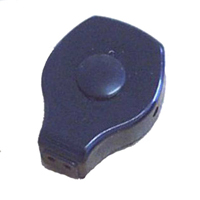
Replacement bone transducer for ACT headphones (1992-2009 - Stenton - Percom).
This miniature inertial transducer works in both directions: it can serve as a microphone or as a loudspeaker. It is notably used for communication and speech enhancement in audio equipment and hearing aids. Physically, the device is teardrop-shaped and made of highly resistant ABS plastic. It measures approximately 31 mm × 24 mm and is about 12 mm thick. It has 2 inserts for mounting a headband, which can be supplied as an option. A dome is fitted on the face for better contact with the head. Unlike many other inertial transducers, which exhibit a frequency response with a single peak around 1200 Hz, this vibrator offers an almost linear response from 500 Hz to 14000 Hz, +/- 4 dB. The sound is therefore clear, with good reproduction of the harmonics.
Although it can be used as a microphone, the main application of this transducer is to function as a sound receiver for hearing in assistive devices. The sensor is worn on the head, most often on the mastoid bones behind the ear flap. It transmits the sound directly to the fluids of the cochlea, thereby bypassing the eardrum and the chain of ossicles. It is therefore possible, for a person with limited hearing - whether due to a perforated eardrum, or to the blockage or breakage of the bones of the ear - to hear using bone conduction.
- Impedance: 68 ohms (nominal)
- Sensitivity (receiver), in free air: 100 mW for 0.2 G at 500 Hz
- Perceived sensitivity (receiver), in free air: 25 mW for 110 dBSPL
- Maximum output power (RMS): 250 mW max
- Power (50% duty cycle): 500 mW
- Frequency response: 40 - 14000Hz +/- 4 dB
- 2-pole connector
- Colour: Black